

CASA NOIR
Contemporary Luxury Loungewear
Studio Nayéh Concept Project
Product Development | Pattern Development | Sourcing | Sampling | Manufacturing
THE PROJECT
Casa Noir is a contemporary luxury loungewear concept developed around the idea that comfort & sophistication
should exist within the same wardrobe
The collection explores relaxed silhouettes, refined proportions & elevated everyday pieces
designed to move seamlessly between home, travel and modern city living
The capsule is designed as a cohesive wardrobe, with individual pieces working independently
while also allowing multiple combinations across the collection
PROJECT OVERVIEW
NUMBER OF STYLES
SIX
CATEGORY
WOMENSWEARPOSITIONING
LUXURY LOUNGEWEARDEVELOPMENT
PORTUGAL
THE BRIEF
The objective was to create a premium loungewear collection that felt:
Sophisticated but effortless | Comfortable without appearing overly casual | Minimal without becoming basic
Versatile across home, travel and everyday wear | Cohesive as a complete wardrobe | Suitable for premium commercial production
The collection was developed around soft, fluid fabrics, restrained detailing and strong silhouettes,
allowing the materials and construction to become an integral part of the design language
OUR APPROACH
-
The collection was defined as a six-style contemporary loungewear capsule, balancing close-fitting foundation pieces with relaxed and oversized layers.
We established:
+ Product specifications: Bodysuit, sculpted lounge top, bias slip skirt, tailored jogger, cropped wrap knit and cocoon cardigan.
+ Silhouette direction: Second-skin, relaxed and oversized proportions creating contrast across the collection.
+ Garment proportions: Body length, rise, volume, layering relationships and overall silhouette balance.
+ Functional requirements: Comfort, movement, layering and versatility between home, travel and everyday wear.
+ Construction direction: Stretch construction, wrap construction, bias-cut development and soft structured silhouettes.
+ Design detailing: Necklines, waistbands, cuffs, fastenings, pockets and edge treatments defined by style.
+ Production intent: A premium loungewear collection designed for consistent commercial production.
This established the technical product brief for each style before pattern development.
-
Material development focused on achieving the different levels of stretch, drape and structure required across the collection.
We established:
+ Fabric composition: Materials appropriate for close-fitting, fluid and soft-structured garments.
+ Stretch & recovery: Required stretch percentage and recovery for the bodysuit and fitted top.
+ Fabric weight: GSM appropriate to the intended structure, layering and seasonal use.
+ Drape & hand feel: Fluidity for the bias skirt and controlled body for the jogger and layering pieces.
+ Dimensional stability: Shrinkage, recovery and behaviour during construction and finishing.
+ Edge stability: Suitability for necklines, armholes, hems, cuffs and wrap edges.
+ Material compatibility: Supporting components selected to work with stretch and fluid fabric constructions.
This established the material parameters required before pattern and sample development.
-
Patterns were developed around the contrasting construction and fit requirements of the six styles.
We established:
+ Fit blocks: Close-fitting and relaxed pattern bases appropriate to each garment type.
+ Ease & negative ease: Controlled ease and stretch allowance for fitted styles, with additional volume for the relaxed silhouettes.
+ Body shaping: Bust, waist, hip and torso shaping developed according to each silhouette.
+ Pattern balance: Front, back, side seam and key balance points established for correct garment hang.
+ Grain & bias direction: Pattern orientation controlled particularly for the bias-cut skirt.
+ Construction details: Wrap overlap, fastening positions, cuffs, necklines, seams and edge treatments incorporated into the patterns.
This created the base patterns required for physical sampling and fit validation.
-
Physical samples were used to validate both fit and material behaviour across the different garment constructions.
We assessed:
+ Fit & ease: Body fit, negative ease, wearing ease and movement.
+ Proportion: Garment length, rise, volume, sleeve balance and layering relationships.
+ Stretch behaviour: Recovery and distortion through fitted garments and high-movement areas.
+ Bias behaviour: Drop, twisting and hem stability of the bias-cut skirt.
+ Construction: Seam performance, fastening placement, wrap tension and edge finishing.
+ Garment balance: Overall silhouette when worn and in combination with other collection pieces.
+ Sample corrections: Pattern and measurement adjustments recorded and incorporated before technical finalisation.
This validated the relationship between the pattern, fabric and finished garment before production documentation.
-
Once the samples were validated, the approved styles were translated into production-ready technical documentation.
We established:
+ Final CAD patterns: Corrected patterns reflecting the approved samples.
+ XS–XL grading: Size grading with consistent proportional increments.
+ A0 layouts: Plotter-ready digital pattern layouts.
+ Measurement specifications: Final measurements and tolerances based on validated samples.
+ Construction specifications: Seams, finishing, fastenings, hems and component placement documented by style.
+ BOM & consumption: Materials, components and final fabric requirements documented.
+ Manufacturing specifications: Operation sequence, machinery requirements and estimated operation timings.
This converted the validated garments into a complete technical reference for production.
-
Sourcing was developed around the contrasting material and construction requirements of the six-style collection, with components selected according to how each garment needed to perform.
We established:
+ Stretch fabrics: Ribbed or stretch jersey qualities with controlled recovery for the second-skin bodysuit and sculpted lounge top.
+ Fluid woven fabric: A lightweight, fluid quality with sufficient drape and stability for the bias-cut slip skirt.
+ Soft structured fabric: A medium-weight quality with enough body and recovery for the tailored jogger and to maintain a clean, refined silhouette.
+ Knit / knit-look materials: Soft, stable qualities suitable for the cropped wrap and oversized cocoon cardigan, with attention to recovery and shape retention.
+ Closures & fastenings: Snaps for the bodysuit, wrap fastening requirements and any required garment closures specified according to construction.
+ Labels & trims: Brand labels, care labels and supporting trims selected for compatibility with stretch and knit-based constructions.
+ Production suitability: Materials assessed for availability, usable width, minimum quantities, repeatability and compatibility with the approved manufacturing methods.
This ensured that each material and component was sourced according to the technical requirements of its specific garment, rather than applying one material solution across the collection.
-
Manufacturing was planned around the different construction methods and material behaviours across the six-style collection, rather than treating the range as a single production process.
We established:
+ Stretch garment construction: Specialist handling for the ribbed bodysuit and sculpted lounge top, including controlled stretch during cutting and sewing to maintain fit and recovery.
+ Bias-cut construction: Careful cutting, handling and settling of the slip skirt to control fabric distortion and achieve an even finished hem.
+ Tailored construction: Structured assembly for the soft tailored jogger, including waistband, pocket and leg construction while retaining the intended relaxed fit.
+ Wrap construction: Controlled overlap, fastening placement and edge finishing for the cropped wrap knit.
+ Cocoon construction: Panel, shoulder and sleeve assembly for the oversized cardigan, maintaining the intended volume without unnecessary bulk.
+ Finishing & pressing: Construction-specific pressing, hems, edges, seams and final garment preparation according to each material.
+ Quality control: Final measurements, stretch recovery, seam quality, symmetry, component placement and finishing checked against the approved samples and technical specifications.
This ensured that each garment moved into production with construction methods appropriate to its specific fabric, silhouette and technical requirements.

THE RESULT
The Casa Noir concept demonstrates a complete development pathway:
CONCEPT
|
PRODUCT DEVELOPMENT
|
PATTERN DEVELOPMENT
|
SAMPLING
|
TECHNICAL DEVELOPMENT
|
SOURCING
|
MANUFACTURING
|
QUALITY CONTROL
|
DELIVERY
|
CONCEPT | PRODUCT DEVELOPMENT | PATTERN DEVELOPMENT | SAMPLING | TECHNICAL DEVELOPMENT | SOURCING | MANUFACTURING | QUALITY CONTROL | DELIVERY |
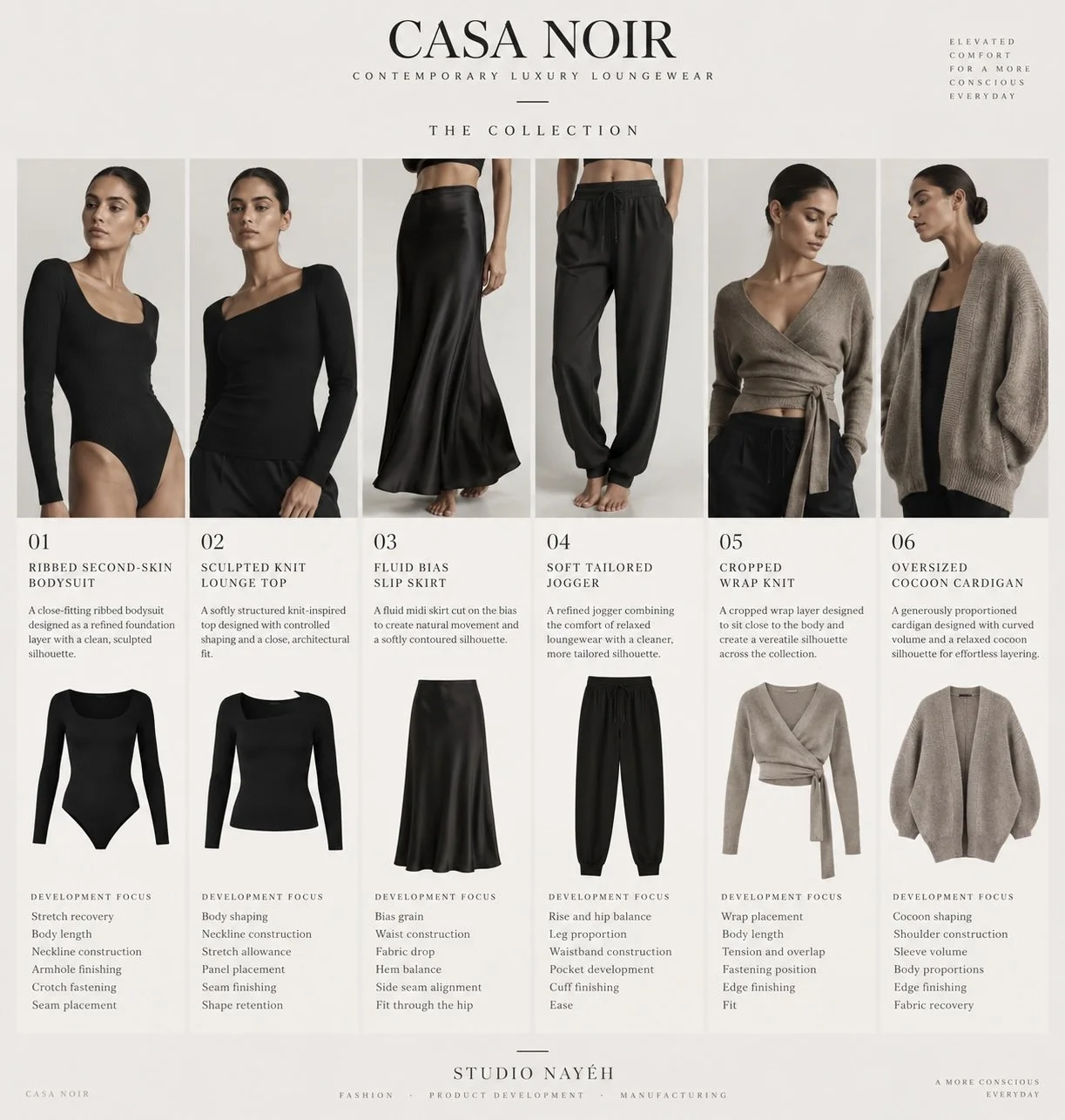
THE COLLECTION
-
A close-fitting ribbed bodysuit designed as a refined foundation layer with a clean, sculpted silhouette.
Development focus:
Stretch recovery | Body length | Neckline construction | Armhole finishing | Crotch fastening | Seam placement -
A softly structured knit-inspired top designed with controlled shaping and a close, architectural fit.
Development focus:
Body shaping | Neckline construction | Stretch allowance | Panel placement | Seam finishing | Shape retention -
A fluid midi skirt cut on the bias to create natural movement and a softly contoured silhouette.
Development focus:
Bias grain | Waist construction | Fabric drop | Hem balance | Side seam alignment | Fit through the hip -
A refined jogger combining the comfort of relaxed loungewear with a cleaner, more tailored silhouette.
Development focus:
Rise and hip balance | Leg proportion | Waistband construction | Pocket development | Cuff finishing | Ease -
A cropped wrap layer designed to sit close to the body and create a versatile silhouette across the collection.
Development focus:
Wrap placement | Body length | Tension and overlap | Fastening position | Edge finishing | Fit -
A generously proportioned cardigan designed with curved volume and a relaxed cocoon silhouette for effortless layering.
Development focus:
Cocoon shaping | Shoulder construction | Sleeve volume | Body proportions | Edge finishing | Fabric recovery