

SOLA
Businesswear Collection
Studio Nayéh Concept Project
Product Development | Pattern Development | Sampling & Fit Validation | Technical Development | Sourcing | Manufacturing
THE PROJECT
Sola is a contemporary womenswear concept developed around a modern approach to business dressing
The collection explores the space between traditional tailoring and modern everyday workwear, combining structured silhouettes with softer,
more versatile pieces designed for the realities of contemporary professional life
The collection is built around interchangeable garments that can move between office, meetings, travel and after-work settings,
allowing the wearer to create multiple looks without relying on conventional corporate suiting
The development focuses on proportion, fit, tailoring, fabric performance and construction, creating a collection that feels polished without becoming overly formal
PROJECT OVERVIEW
NUMBER OF STYLES
SIX
CATEGORY
WOMENSWEARPOSITIONING
BUSINESSWEARDEVELOPMENT
PORTUGAL
THE BRIEF
The brief was to develop a contemporary businesswear collection that could replace traditional corporate dressing with a more modern and versatile wardrobe
The collection needed to balance:
Structured tailoring with softer silhouettes | Professional presentation with everyday wearability | Clean construction with comfortable movement
Individual statement pieces with strong wardrobe compatibility | Premium appearance with commercially viable production
The product direction was centred on modern tailoring, controlled proportions and versatile styling,
allowing the collection to transition between office environments, meetings, business travel and after-work settings
OUR APPROACH
-
The collection was defined as a six-style businesswear wardrobe, balancing tailored separates with softer pieces that could be combined across multiple professional looks.
We established:
+ Product specifications: Blazer, trouser, vest, skirt, blouse and tailored dress.
+ Silhouette direction: Structured tailoring balanced with controlled fluidity and contemporary proportions.
+ Garment proportions: Shoulder width, jacket length, trouser rise, leg volume, skirt length and dress shaping.
+ Functional requirements: Movement, layering, desk-to-meeting wearability and compatibility between separates.
+ Construction direction: Soft tailoring, structured waistlines, tailored closures and controlled garment shaping.
+ Design detailing: Lapels, pockets, waistbands, cuffs, buttons, closures and seam lines defined by style.
+ Production intent: A premium businesswear capsule designed for repeatable commercial production.
-
Material development focused on achieving structure, drape and comfort across the different tailoring silhouettes.
We established:
+ Tailoring cloths: Woven qualities with sufficient body and recovery for blazers, trousers and structured skirts.
+ Fluid qualities: Lighter materials suitable for the blouse and softer elements of the collection.
+ Fabric weight: GSM selected according to garment structure, seasonality and intended drape.
+ Drape & recovery: Controlled movement without compromising the shape of tailored garments.
+ Dimensional stability: Shrinkage and fabric behaviour considered before final construction.
+ Tailoring support materials: Interlinings, fusibles, shoulder support and other internal materials matched to the required level of structure.
-
Patterns were developed around the balance and construction requirements of contemporary tailoring.
We established:
+ Tailoring blocks: Structured blocks developed for the blazer, vest, skirt and dress.
+ Pattern balance: Front, back, shoulder and side-seam balance established for clean garment hang.
+ Ease allocation: Controlled wearing ease allowing professional movement without losing silhouette definition.
+ Shaping: Dart, panel, waist and body shaping developed according to each garment.
+ Sleeve engineering: Sleeve pitch, cap height and armhole relationship established for the blazer and blouse.
+ Construction details: Lapels, pockets, waistbands, closures, seam allowances and notches incorporated into the patterns.
-
Physical samples were used to validate the relationship between the tailoring patterns, fabrics and finished silhouettes.
We assessed:
+ Shoulder & chest balance: Blazer and vest fit through the upper body and armhole.
+ Sleeve pitch: Sleeve movement and alignment through the shoulder.
+ Waist & hip fit: Trouser, skirt and dress shaping across the body.
+ Garment proportions: Jacket, skirt, trouser and dress lengths reviewed against the intended silhouette.
+ Movement: Functional ease assessed through sitting, walking and arm movement.
+ Construction: Lapels, pockets, closures, waistbands and internal support reviewed during sampling.
+ Sample corrections: Pattern and measurement adjustments incorporated before technical finalisation.
-
Once the tailored samples were validated, the approved styles were translated into production-ready technical documentation.
We established:
+ Final CAD patterns: Corrected patterns reflecting the approved samples.
+ XS–XL grading: Size grading with proportional increments appropriate to each garment.
+ A0 layouts: Plotter-ready digital pattern layouts.
+ Measurement specifications: Final garment measurements and tolerances.
+ Construction specifications: Tailoring seams, hems, closures, pockets and finishing requirements.
+ BOM & material requirements: Main fabrics, interlinings, buttons, closures and other components.
+ Manufacturing specifications: Operation sequence, machinery requirements and estimated operation timings.
-
Sourcing was developed around the different material and construction requirements of the collection.
We established:
+ Tailoring fabrics: Wool, wool-blend or premium structured woven qualities suitable for the blazer, trousers, vest and skirt.
+ Fluid blouse fabrics: Lightweight woven qualities with appropriate drape and recovery.
+ Dress fabrics: Structured but comfortable qualities capable of maintaining the column silhouette.
+ Interlinings & fusibles: Support materials selected according to the required structure of each tailored garment.
+ Buttons & closures: Buttons, zips, hooks and other closures specified according to garment construction.
+ Labels & trims: Branding and care components compatible with the selected fabrics and finishing requirements.
-
Manufacturing was planned around the technical requirements of tailored garments rather than treating the collection as standard cut-and-sew production.
We established:
+ Tailoring construction: Structured assembly for the blazer and vest, including internal support and controlled pressing.
+ Trouser construction: Waistband, fly, pocket and leg assembly with attention to crease and leg alignment.
+ Skirt construction: Panel assembly, waist construction and closure installation maintaining clean shaping.
+ Blouse construction: Lightweight fabric handling, sleeve insertion, cuffs and neckline finishing.
+ Dress construction: Controlled body shaping, closure installation and internal finishing.
+ Pressing & finishing: Pressing stages integrated throughout production to establish and maintain the intended tailored shape.
+ Quality control: Measurements, balance, seam quality, pressing, closures, symmetry and finishing checked against approved samples and technical specifications.
This ensures that the precision established during pattern development and sampling is maintained through finished production.

THE RESULT
The Sola concept demonstrates a complete development pathway:
CONCEPT
|
PRODUCT DEVELOPMENT
|
PATTERN DEVELOPMENT
|
SAMPLING
|
TECHNICAL DEVELOPMENT
|
SOURCING
|
MANUFACTURING
|
QUALITY CONTROL
|
DELIVERY
|
CONCEPT | PRODUCT DEVELOPMENT | PATTERN DEVELOPMENT | SAMPLING | TECHNICAL DEVELOPMENT | SOURCING | MANUFACTURING | QUALITY CONTROL | DELIVERY |
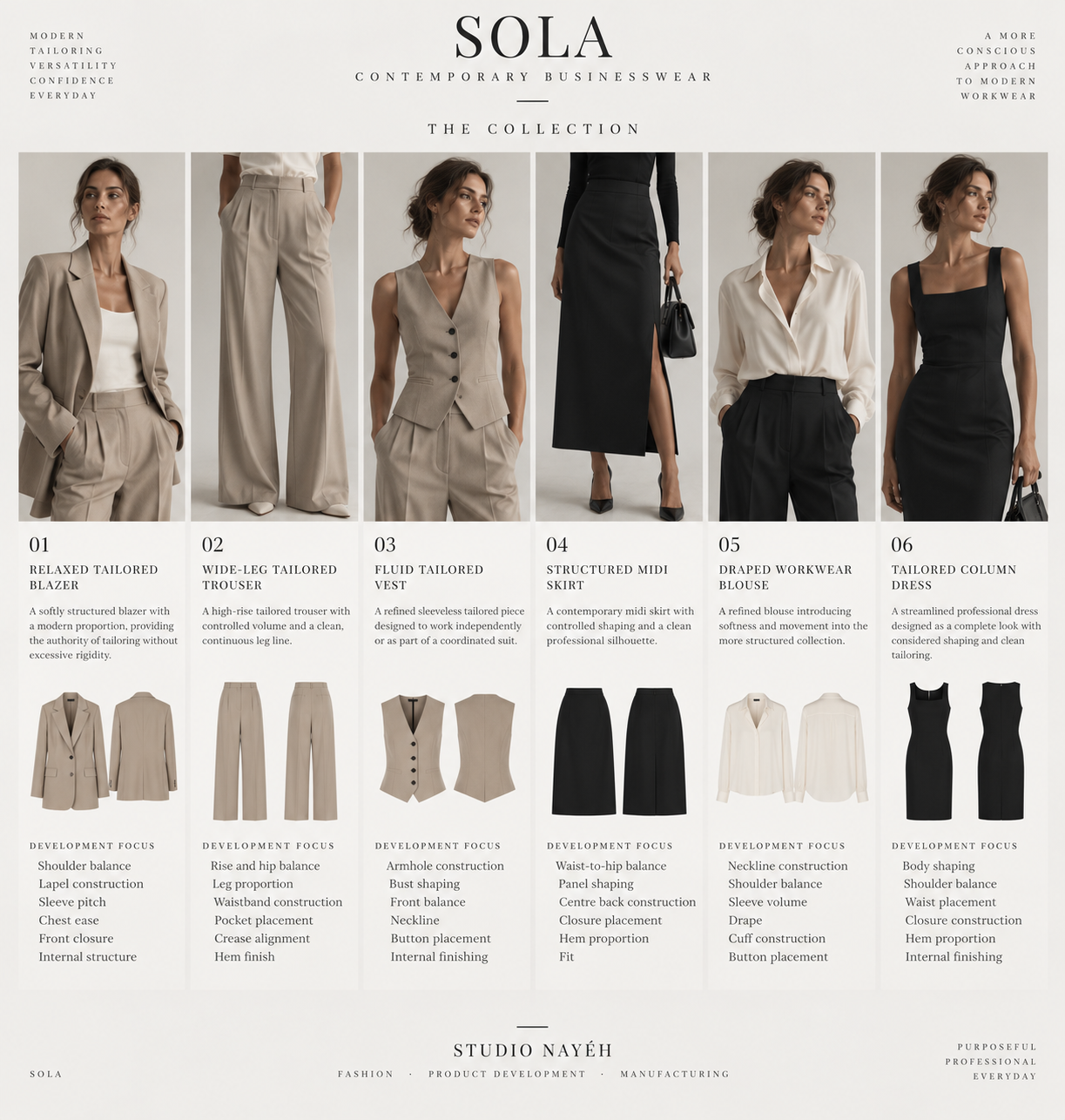
THE COLLECTION
-
A softly structured blazer designed with a contemporary proportion, providing the authority of tailoring without excessive rigidity.
Development focus:
Shoulder balance | Lapel construction | Sleeve pitch | Chest ease | Front closure | Internal structure -
A high-rise tailored trouser with controlled volume and a clean continuous leg line.
Development focus:
Rise and hip balance | Leg proportion | Waistband construction | Pocket placement | Crease alignment | Hem finish -
A refined sleeveless tailored piece designed to function independently or as part of a coordinated suit.
Development focus:
Armhole construction | Bust shaping | Front balance | Neckline | Button placement | Internal finishing -
A contemporary midi skirt with controlled shaping and a clean professional silhouette.
Development focus:
Waist-to-hip balance | Panel shaping | Centre back construction | Closure placement | Hem proportion | Fit -
A refined blouse introducing softness and movement into the more structured tailoring pieces.
Development focus:
Neckline construction | Shoulder balance | Sleeve volume | Drape | Cuff construction | Button placement -
A streamlined professional dress designed as a complete look with considered shaping and clean tailoring.
Development focus:
Body shaping | Shoulder balance | Waist placement | Closure construction | Hem proportion | Internal finishing